Local taxes
In February, most residents of The Hague will receive their annual municipal tax assessment. This assessment includes the property tax (OZB), the waste collection charge, and the sewerage charge. Owners of immovable property—such as a home, building plot or commercial premises—will also receive the valuation of the property value (WOZ) for the new tax year.
The types of local property taxes you pay depend on whether you rent or own your home. For more details about the different charges and the available payment options, please visit your local municipality’s website.
Privileged status and local taxes
Persons with a privileged status may be exempt from paying certain taxes. In general, they have to pay charges for services rendered but may be exempt from paying general taxes. For example, they have to pay the waste disposal and collection, sewerage and water treatment charges, but may be exempt from property tax and water authority tax.
Making local tax payments
Generally, Dutch municipalities accept payments in different ways; by direct debit, online banking and by bank card. Tax payments can either be paid in monthly instalments, usually by direct debit, or all at once.
Find out more about paying your taxes to the Municipality of:
Contesting your assessment
If you believe the municipality has made a mistake when calculating your taxes, the property value (WOZ value), or the administrative fees, you can object to invoices within 6 weeks of the date of the assessment.
Rubbish/waste tax (Afvalstoffenheffing) - paid by the user of the property
The municipality decides how much waste collection tax you must pay. To do this, it checks the Personal Records Database (BRP) to see how many people are registered at your address, using the household size as of 1 January.
The waste collection tax is based on fixed rates. The amount you pay depends on the number of people in your household.
Do you have a low income and no capital (for example, savings, your own home or a car)? Request a waiver for your municipal taxes.
More information about waste tax and current tax rates for residents of:
Wastewater tax (Rioolheffing) - paid by both the user and owner of the property
Most homes and buildings are connected to the main municipal sewer system. If you discharge more than 500 cubic metres (m³) of wastewater into this system each year, you must pay the sewerage charges for users. If you are also the owner of a property with a connection to the municipal sewer system, you must pay the sewerage charges for owners as well.
More information on the wastewater tax for residents of:
Property tax (Onroerende zaakbelasting/ OZB) - paid by the owner of the property
If you own a property, you will receive a municipal property tax bill (woonlastennota) each February, with the amount of property tax you must pay. This is calculated based on the value of your property (the WOZ value). Please note that if you live in a houseboat, you pay a slightly different tax called roerende zaakbelasting; and will also have to pay for the ‘rent’ of your mooring.
More information about property taxes for residents of:
Water authority tax (Waterschapsbelasting) - paid by both the user and owner of the property
Water authority tax is a tax paid to your local water board (interestingly, Dutch water boards are some of the eldest democratically elected institutions in the world). The tax is used to service dykes, maintain sewers, and to generally keep everyone’s feet dry. Both tenants and property owners must pay water authority charges, but each is responsible for different parts of the bill.
Nearly a third of the Netherlands lies below sea level. It’s exactly that reason why people refer to the Netherlands as “the Land of Water”. There’s a saying “God created the earth, but the Dutch created the Netherlands”. And as that may sound silly, it could very much be true. We need to protect ourselves against water; on a daily basis. A total of 21 Dutch Water Boards work to manage water barriers, waterways, water levels, dikes, water quality and sewage.
Delfland Water Authority
The Delfland Water Authority takes care of the maintenance of dikes and dams, water level control and water quality control for The Hague, Delft and Midden-Delfland.
The tasks of water boards remained basically unchanged since their first formation. They are in fact the oldest democratic institution in the Netherlands. In many Dutch towns you can visit historic buildings that used to house the water boards, including their very own coat of arms! You can still visit the house Delfland Water Authority used in 1645 in Delft. So, do not just pay your tax assessment, but visit Delft and make the most out of it.
Why did you receive a tax assessment of the RBG?
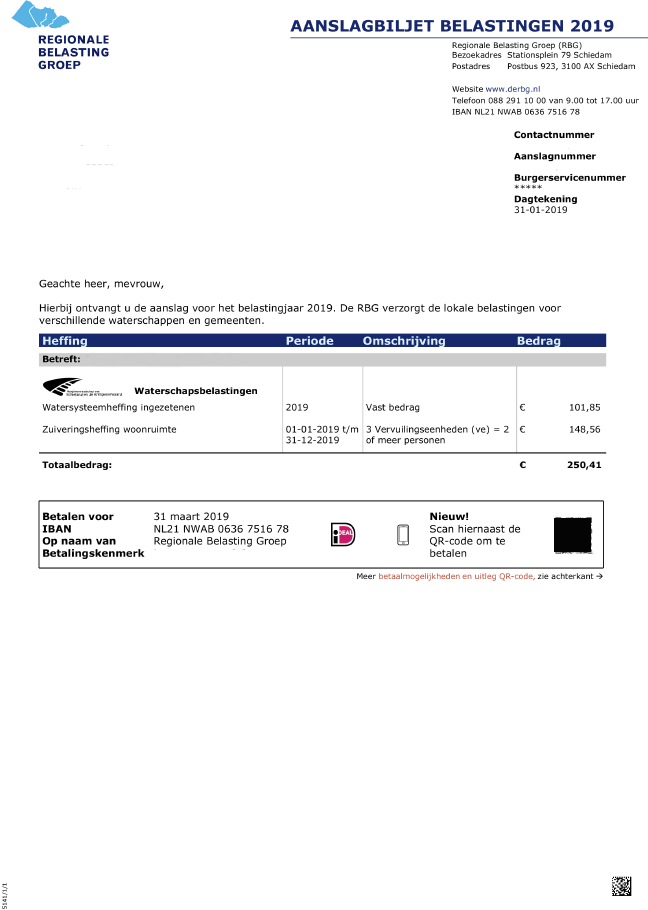
The implementation of the main tasks of the Water Authority is financed through taxes. And that is exactly why you have received this tax assessment from the ‘Regionale Belasting Groep’ (RBG).
Regionale Belasting Groep
The RBG is responsible for collecting taxes on behalf of the Delfland Water Authority. Depending on your situation, the tax assessment includes two or three payments:
- Watersysteemheffing eigenaren (if you are the owner of the property)
- Watersysteemheffing ingezetenen (if you are the user of a residence)
- Zuiveringsheffing (one unit of pollution for a single person household and three units of pollution for a multiperson household)
The RBG receives its information directly from municipalities and the Land Registry. Be sure to always report changes in your living situation to your municipality. The RBG published a webpage with an FAQ about submitting an objection, in case of an incorrect tax assessment. Be sure to lodge your objection with the RBG within six weeks of the date of the assessment. Please note: you’ll need your DigiD to object the tax assessment.
(Partial) tax exemption
Privileged status holders are eligible for a partial exemption. Exemption from the water system charge for occupants ('watersysteemheffing ingezetenen') is granted. This exemption does not apply if you have the Dutch nationality or you are considered to be a permanent resident of the Netherlands. When in doubt, be sure to contact the RBG about partial tax exemption, as this could also depend on your diplomatic status. You can contact the RBG on +31 88 291 10 00.
Exemption is not available for wastewater treatment charge ('zuiveringsheffing'), as this is a charge for a specific service like water treatment, water pollution, waste disposal, waste collection and sewage.
On the website of the RBG you can find lots of information about paying the tax assessment. If you want to pay your assessment online, you’ll need to enter your DigiD information to log in.
Elections of the Water Board
Water authority elections are held every four years, at the same time as the provincial council elections. Internationals are eligible to vote if they meet the conditions set out on the official website (in Dutch). Before the election, all eligible voters receive a voting card by post, which indicates the date, time and location of their polling station.